
Pickens Parole Board Search Routes
The Georgia Parole Board links separate tools for people before and after parole release. Use Inmate TPM Lookup for a parole-review target while a person remains in state custody. Use Parolee Search for a public record of someone on parole. Use GDC Find an Offender to confirm state custody and sentence information.
- Establish that the Pickens case produced a GDC sentence.
- Search GDC for the correct person and state identifier.
- Use TPM Lookup only for a tentative review month.
- Use Parolee Search to check actual public parole status.
- Contact DCS for the appropriate local field-supervision route.
A person who bonded out of the Pickens County jail is not automatically a parolee. A probation sentence is also not parole. The Board's tools apply to the state parole process, not all local releases.
The official Board home page displays the parole systems used in this process.
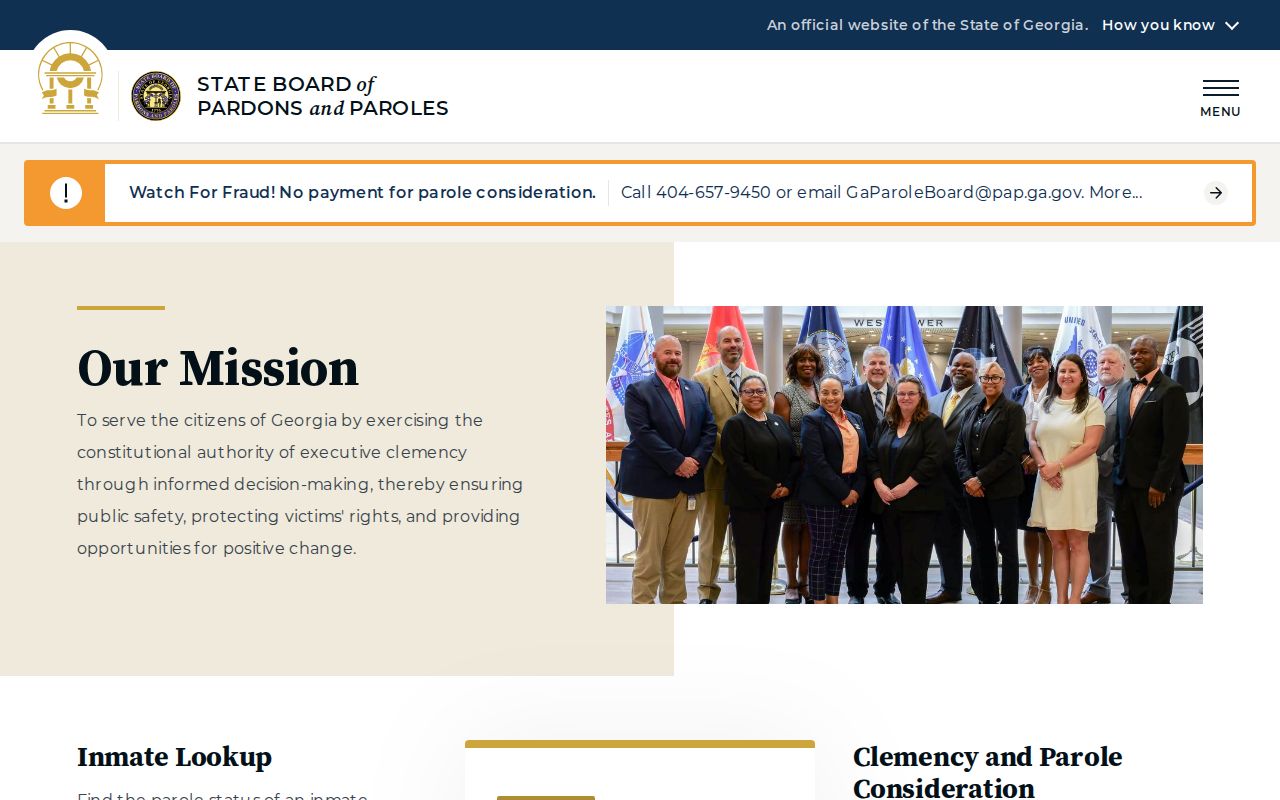
The source helps route the search, but an online result should still be matched to GDC and court identifiers.
Pickens TPM Is Not Release
A Tentative Parole Month, or TPM, is the point at which the Board plans to complete final review and, if appropriate, set a parole release date. It is conditional. Good conduct and program completion can matter, and misconduct reports usually cause postponement or cancellation. A month in the lookup does not establish that a person left custody.
The distinction matters for Pickens families and court participants because a state transfer already removed the person from the county roster. Someone can be absent from Pickens JailTracker, have a TPM, and still remain in GDC custody. Confirm current status through GDC. After the Board authorizes release, look for an actual parole record and DCS supervision.
- Eligibility date
- The point when the law permits parole consideration, not a grant.
- TPM
- A tentative final-review month that can change.
- Parole release
- Conditional community release authorized by the Board.
- Maximum release
- The state sentence's maximum-release target rather than a parole promise.
Georgia Parole Decision Process
Eligible state offenders are considered under the Georgia process; they do not need a public meeting vote to begin routine consideration. The Board can set a TPM or deny parole. Eligibility generally arises after statutory minimums for qualifying sentences, but the Board notes that few people receive parole at their first eligibility point.
O.C.G.A. § 42-9-45 contains the main eligibility framework and exceptions. General rules described in the research include six months or one-third for a misdemeanor sentence and nine months or one-third for a felony sentence, whichever applicable period is greater, subject to other law. Eligibility is not a release order.
Serious violent felony rules under O.C.G.A. § 17-10-6.1, repeat-offender provisions, mandatory minimums, sentence structure, detainers, credits, conduct, and Board judgment can change the outcome. Do not apply one universal percentage to every Pickens sentence.
| Stage | Public source | Meaning |
|---|---|---|
| State custody | GDC offender search | Current state status and sentence data |
| Parole review target | TPM Lookup | Tentative final-review month |
| Parole status | Parolee Search | Public record after parole begins |
| Field supervision | DCS | Community supervision after release |
Public Meetings and Pickens Cases
Board public meetings address agency policy and operations. They are not hearings where routine individual offender parole decisions are made. A public meeting notice or agenda should not be treated as the decision calendar for a specific Pickens prisoner. Offender review follows the Board's parole process and record tools.
The distinction prevents two common errors: expecting a named prisoner's vote to appear on a public monthly agenda, and interpreting the absence of a name as denial. Use the person's GDC information, TPM result when available, and parole status. Direct case-specific questions to the Board's established contact routes.
The Board's official explanation of public meetings shows their policy and operational role.
This meeting source is context, not a personal parole-release confirmation.
Parole Versus Pickens Probation
Parole follows release from a state prison sentence under Board authority. Probation is imposed by a court and can be served instead of confinement or after part of a split sentence. DCS supervises felony parolees and probationers, but the shared field agency does not make the two legal statuses identical.
A person released from the Pickens jail on bond may have special conditions through the court or Appalachian Misdemeanor Pretrial & Probation Program. That person may never appear in Parolee Search. A person serving felony probation should be verified with the sentence order and DCS, not by assuming a missing parole result means no supervision.
The Probation & Parole page provides the local Pickens office distinctions. Use the Board page for parole decisions and the court file for probation authority.
After Pickens Parole Release
The Georgia Department of Community Supervision takes the field role after parole begins. The Jasper DCS Field Office serves Pickens, Fannin, Gilmer, and the Appalachian Circuit. The research lists the local office at 50 North Main Street in Jasper, open Monday through Friday from 8:00 a.m. to 4:30 p.m., with a Pickens DCS phone of 706-692-4805.
DCS can address appropriate questions about active felony community supervision. It does not prove the date someone left the Pickens jail, and it does not replace the Board's parole decision. The parolee database, Board record, and DCS status describe separate steps.
DCS Jasper Field Office50 North Main Street
Jasper, GA 30143
Phone: 706-692-4805
Monday-Friday, 8:00 a.m.-4:30 p.m.
Supervision may be based on residence, so a person sentenced in Pickens may later report through another DCS office.
Pickens Work-Release Parole Path
Some GDC offenders move into transitional centers or work release before parole. GDC says most work-release participants stay about six months and then release on parole, while non-parole-eligible offenders leave after the full sentence is served. This statewide path can apply to a Pickens sentence but does not create a local Pickens work-release facility.
A transitional placement is still state custody. The move should not be reported as community release. Check the GDC location, then verify the later Board decision and parole record. Performance Incentive Credit may also alter an eligible TPM or Maximum Release Date, but it does not guarantee parole.
Parole Violations and Pickens Custody
An absconder or parole-warrant status does not prove current detention at the Pickens jail. It signals alleged noncompliance or wanted status. Check the parolee record, DCS, official warrant channels where available, and the current jail roster. No official Pickens public absconder list was found in the research.
A violation can lead to arrest, revocation proceedings, continued parole, or return to custody. The final decision record controls. If the person enters Pickens custody, the current roster may show the booking, while the Board and DCS records explain the supervision basis. If a warrant is recalled or a matter resolved, preserve that official record rather than relying on an old status.
Verify Pickens Parole Release
Use the Parolee Search to check public active parole status, but do not assume every released state inmate appears. A person can discharge, max out without parole, begin probation, or have another status. Pair the Board result with GDC release data and the court sentence.
Georgia VINE can be tried for custody-change notification where the agency supplies a record. It is not the parole decision or discharge record. Pickens JailTracker's public VINE endpoint does not show VINE enabled, so county-jail notice coverage must be verified separately.
Final proof should identify the actual release event, Board authority when parole applies, and the office supervising the person. A TPM alone fails that test. A complete record distinguishes eligibility, tentative review, actual release, active supervision, and eventual discharge.
A formal record may be needed to document a decision or discharge. Identify the person with the GDC number and sentence information. Ask for the existing Board record that addresses the event, not a new narrative of the whole case. Some investigative, medical, and security-sensitive material may remain protected.
Parole release and parole discharge occur at different times. Release begins conditional supervision. Discharge ends the parole obligation through authorized action or sentence completion. A missing public result alone does not prove parole ended. Ask for official status.
If probation follows a split sentence, parole discharge may leave court-ordered probation active. The sentence and DCS record identify the next obligation. Keep the release decision, parole start, supervision record, and final discharge together. They form the timeline from GDC confinement to the end of supervision, while a TPM remains only a tentative marker.
Each date needs its agency label.
Public Record Search
Sponsored Results